





In a recent sermon on David’s famous Twenty-third Psalm, ‘The Lord is my Shepherd’, I sheepishly confessed that I had referred to the word ‘my’ as a personal pronoun, when in fact, it is a possessive pronoun. Believe it or not, there are eight different subcategories of pronouns in the English grammar: personal, relative, demonstrative, indefinite, reflexive, interrogative, reciprocal, and possessive. How exciting! But I think most of my listeners yawned at the point, or at least wanted to.
Yet the point is actually not pedantic. The word ‘me’ is a personal pronoun, but unless the ‘me’ becomes a ‘my’, there is no possession. And when the subject is salvation, non-possession is a serious miscalculation. The Lord is indeed a shepherd, whether we trust Him or not, and a good shepherd at that. But unless the Lord is my shepherd, all the good promises held out in the Psalm, namely comfort in the dark valley, and a forever dwelling in the house of the Lord, remain unclaimed.
Thankfully, a person is not saved by grammatical correctness, for who then could be saved? Not I. Or is it ‘Not me’? Thankfully there is a way to secure salvation by not using the possessive pronoun. John Newton discovered it, and put it like this: ‘Amazing grace how sweet the sound, that saved a wretch like me. I once was lost, but now am found; was blind, but now I see’. But who will not agree that his personal is also his possessive?


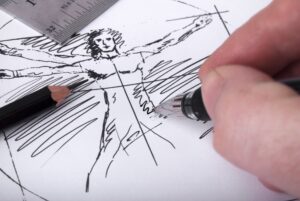
Vitruvian Man DM 4th September 2026 The Roman architect Vitruvius proposed that the human body could perfectly fit inside both a circle and a square,